
Reference sample → written criteria → inspection
A clear reference. An agreed standard.
Quality starts with a shared definition of the product. Connect the specification, approved physical sample and packaging details before production decisions are made.
01 / Existing workflow
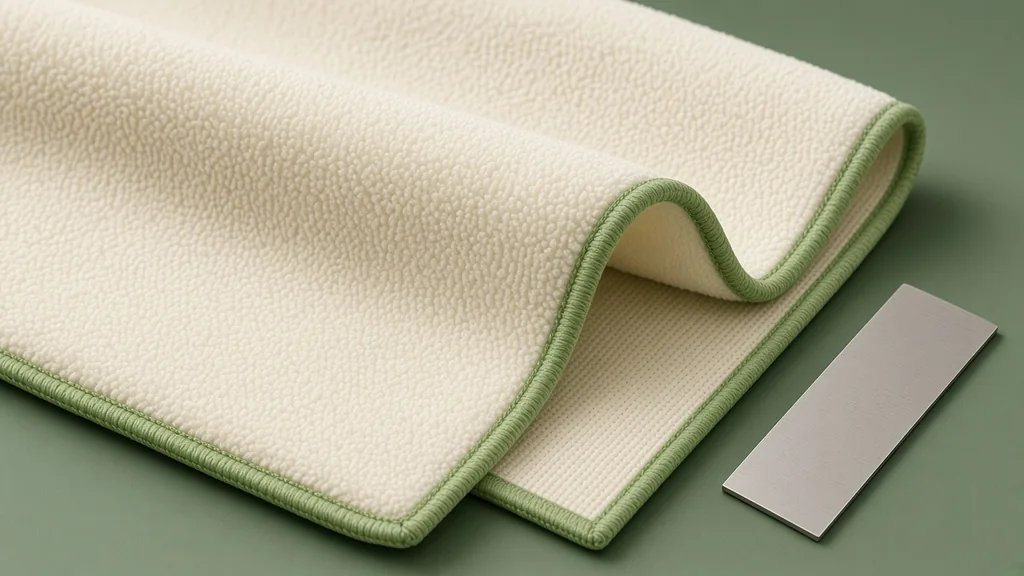
The reference stays at the centre.
This page brings together the workflow already described on our company and OEM pages. It does not present the illustration as inspection evidence or introduce new certification claims.
Retain a physical reference
The published company workflow calls for an approved reference piece held by both parties against the order number. Record the sample identity and approved specification revision so the same object anchors later discussions.
Approve the pre-production sample
Product and packaging are approved in writing before mass production. Record the item, materials, colour, edge and artwork version together; a design preview or photograph is not a substitute for that approval.
Review during production
The existing workflow describes a photo update at roughly 50% completion. Use the agreed reference to discuss visible colour or pack differences. Photos can communicate progress; they do not independently verify hidden material or performance properties.
Plan the pre-shipment inspection
Our published OEM terms specify AQL 2.5 pre-shipment inspection and welcome third-party or buyer inspection. Agree the inspection scope, sampling plan, defect classification and reporting requirements for the order. An AQL reference is not a guarantee of zero defects.
Resolve documentation before dispatch
Identify destination markets, required reports and packaging marks early. Confirm what evidence is needed for the exact product and market. This page does not claim that a specific item has passed a test or holds a certificate.
Read the original company quality section → View published inspection terms →
02 / Prepare the acceptance criteria
A specification checklist — not a test report.
The items below are proposed points for buyer discussion. Select the relevant checks and agree methods, tolerances and acceptance limits in writing. No test equipment, completed testing or performance result is implied.
| Area | What to define | What to agree or request |
|---|---|---|
| Material & construction | Item code, blend, GSM, weave or knit, pile and finished size | Measurement method, conditioning and tolerances appropriate to the selected cloth |
| Colour & appearance | Approved physical colour reference, visible marks and shape | Viewing conditions, acceptable variation and defect examples |
| Edge & seams | Selected edge finish, seam construction and corner shape | Acceptance criteria for loose threads, seam consistency and any required seam evaluation |
| Use & care | Intended surface, care label and claims proposed for retail | Any lint, washing, colourfastness, absorbency or surface-suitability evaluation needed; method and evidence to be confirmed |
| Artwork & packing | Approved artwork revision, label location, pieces per pack and carton marks | Dieline proof, pack count, barcode and text review against approved files |
| Market documentation | Countries of sale and applicable material or labelling requirements | Required reports and their product/material coverage; no report assumed available without confirmation |
03 / Match the evidence to the item
One checklist does not fit every cleaning product.
Our catalogue spans microfiber textiles, cellulose products and other cleaning-tool materials. The company page explains which material domains sit within the joint-venture group and which are coordinated with partner factories.
For a microfiber item, focus on its selected construction, finish and intended surface. For other materials, develop an appropriate specification rather than reusing textile checks without review. Ask what evidence applies to the exact item, not just to a similar product name.
Company & material domainsSend with your quality enquiry
- Product code and current specification revision
- Destination markets and intended use
- Claims you plan to make on the packaging
- Critical defects, acceptance limits and inspection expectations
- Any buyer protocol or report requirements
Inspection arrangements and commercial details remain subject to the agreed order terms. We do not add a new fee policy or timing guarantee here.
04 / Close the loop
Approve, record, then control changes.
Keep written approval, the physical reference and final artwork together. If a size, material, colour, edge or pack changes, record the revision and discuss whether a new sample or evaluation is required. Resolve open points before proceeding rather than assuming the earlier approval covers a changed product.
Bring the specification into focus.
Send the item, intended use, quantity and destination market. Include the decisions you need the sample or quotation to resolve.